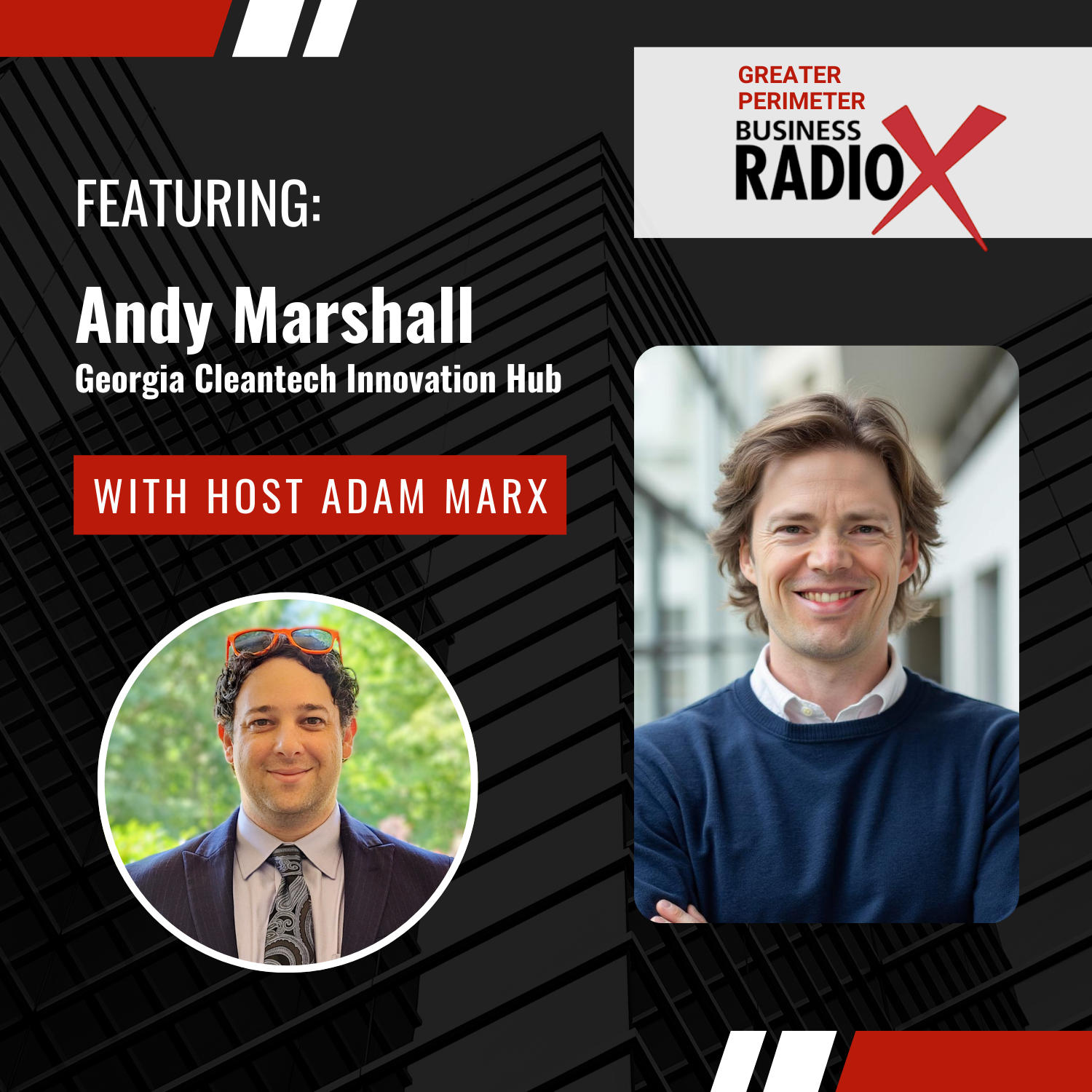

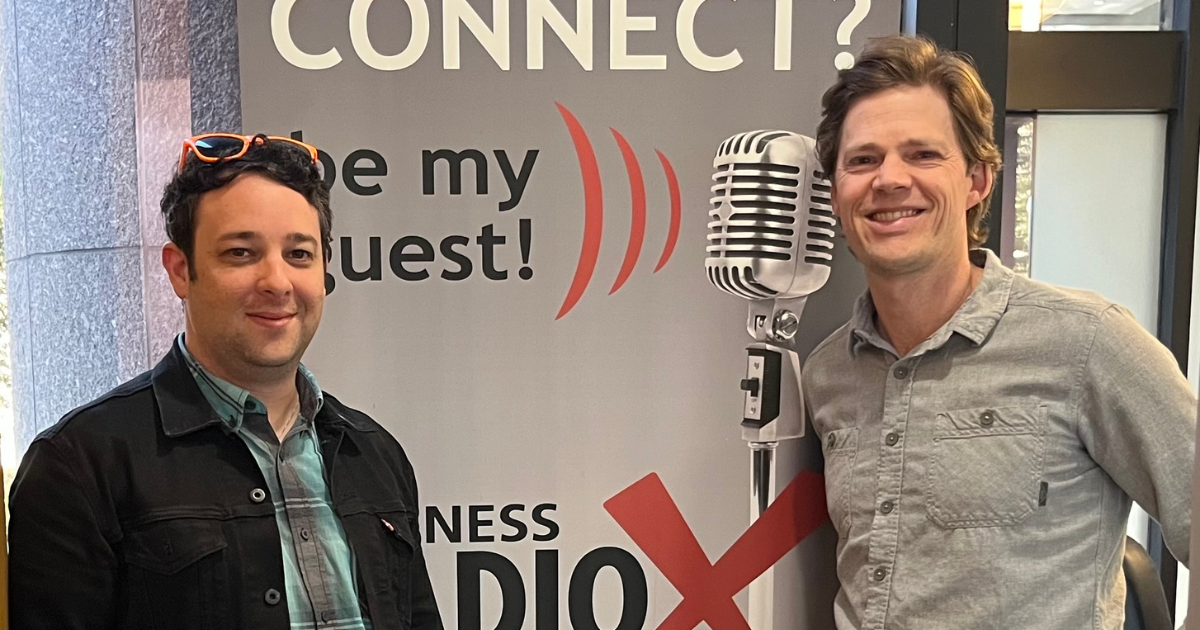
In this episode of Greater Perimeter Business Radio, Adam Marx talks with Andy Marshall from the Georgia Cleantech Innovation Hub. They discuss the importance of networking, ecosystem building, and collaboration in the cleantech and infrastructure sectors. Andy shares insights from his journey as a chemist and startup operator, highlighting the value of meaningful connections and patient relationship-building. The conversation covers the upcoming Super South conference, and the Hub’s initiatives to support startups and students.

 Andy Marshall is the Executive Director of the Greenhouse Accelerator. He has worked for over a decade as a product and technology leader in clean energy and cleantech.
He created product line visions and business plans that secured over $100M in corporate R&D funding and cultivated strategic partnerships with startups and multinational companies that secured over $800M in contracts.
Andy started his business career as a consultant with McKinsey & Company supporting energy, technology, and natural resource clients.
Andy earned a PhD degree in Chemistry from Stanford University and a BS in Chemistry from the University of Notre Dame.
Connect with Andy on LinkedIn.
Episode Highlights
- Innovation in clean technology (cleantech) and infrastructure development
- Importance of networking and relationship cultivation for startups
- Upcoming Super South conference focused on cleantech and local resources
- Challenges of building local networks for startup founders
- The role of the Georgia Cleantech Innovation Hub in fostering innovation and economic development
- Strategies for effective networking and meaningful conversations
- The diverse nature of the cleantech sector and its intersection with various industries
- The significance of community support and collaboration in infrastructure projects
- Future initiatives for incubator space and experiential learning programs in cleantech
- The need for sustained engagement and support for innovators in the cleantech ecosystem
About Your Host
 Adam Marx is a networking & leadership consultant, speaker, startup advisor, journalist & the founder of The Zero to One Networker.
Formerly the founder & CEO of music-tech startup Glipple, Inc., and as a writer appearing in Crunchbase News, Startup Grind, Mattermark, & others, Adam draws on more than a decade of experiences in the music & startup tech industries to teach others how to cultivate powerful relationships using strategies of patience, consistency, authenticity, & value creation.
As a networking consultant and speaker, Adam has worked with numerous organizations, including Georgia State University, TechStars Atlanta, the Atlanta Tech Village, ATDC (through Georgia Tech), & Startup Showdown, where he’s advised & mentored founders on how to develop magnetic dialogues & long-term relationships.
Adam’s talks include those given at Georgia Tech and Georgia State University, with a keynote at Emory University’s The Hatchery and as a featured speaker for Atlanta Tech Week 2024.
In addition to advising & consulting, Adam sits on the steering committee for InnovATL, cohosts LinkedIn Local ATL, emceed the 2022 Vermont SHRM State Conference, and was a workshop speaker at South by Southwest (SXSW) 2025.
He is currently working on his forthcoming book.
Connect with Adam on LinkedIn and Instagram and follow Zero to One Networker on LinkedIn and Instagram.
 This transcript is machine transcribed by Sonix.
TRANSCRIPT
Intro: Broadcasting live from the Greater Perimeter. It’s time for Greater Perimeter Business Radio. Now here’s your host.
Lee Kantor: Today’s episode of Greater Perimeter Business Radio is brought to you by 0 to 1 networker, helping founders, funders, and operators build the strategic relationships and access that move businesses forward. For more information, go to 0 to 1. Networker. Now here’s your host, Adam Marx.
Adam Marx: Wow, we have an exciting show today. We’re going to jump right in. I’m super excited to introduce my guest, Andy Marshall from the Georgia Clean Tech Innovation Hub. And let’s start there.
Andy Marshall: Well, I appreciate it. Thanks for having me on today. Excited to do this. I love talking innovation networking startups with you. It’s going to be a it’s gonna be an awesome call.
Adam Marx: Well, you know, we have some exciting stuff coming up, but before we kind of dig into that in a couple of weeks, we have Super South, which for those who are not familiar with it yet, is a new kind of conference here in Atlanta that is all around clean tech and innovation and energy, local infrastructure, academia, etc. and if memory serves, you’re you’re on on the list of speakers for that.
Andy Marshall: I’m on the list of speakers. I am lucky to be the emcee of the event. One of the MCs, uh, with Maya May from Weathered, the PBS show. So very excited to do that. I am a big believer in Super South. To me, it’s, it’s not just a conference, right? It’s the opportunity for the ecosystem to get together and talk about big ideas, but not, not it’s not like a, we’re not a think tank, right? This is not like, hey, we’re just going to throw around big ideas. It’s, well, how are we going to get this done? How are we going to do it faster? How are we going to do it with the resources we have here?
Adam Marx: Right. Well, and let’s let’s talk about that because I want to start with your, uh, your background, which I know a little bit about, but I want to share with our listeners kind of what your background is and, and your journey into kind of clean tech and, you know, innovation in that, in that context.
Andy Marshall: Yeah, it’s a, it’s a great point because you don’t wander into the not for profit world. Uh, it’s kind of sometimes intentional. And sometimes people look at my, you know, look at my LinkedIn and they’ll be like, tell me the story here, Andy. But yeah. Um, so, you know, I started off as a scientist. I’m a PhD chemist by training. I never really practiced chemistry. I sort of realized in early on in there that I wasn’t a, I wasn’t a bench chemist or wasn’t a bench scientist, but what I really loved was translating technical ideas to non-technical audiences and sort of that’s the that’s where everything comes from. So I went from PhD chemist to management consultant and was working in the mining industry, going underground, working in mining ops. I saw a lot of what, you know, first of all, how critically important the mining industry is and extraction industries are. But I also saw, you know, firsthand how how challenging it was on the environment. Right? And so when I was ready to leave consulting because I wasn’t a career consultant either, I went into startup and I at the time, you know, cleantech was was pretty hot. I found a battery storage startup and, and ran with it. And I got really deep into energy for the next about ten years of my career. So worked on everything from solar to batteries to smart grid. And then, you know, pandemic happened. I got a little antsy and said, well, look, I, I kind of have this chemistry background. I want to get back into that. Um, and so I wanted to start, I started, I was looking to start a company and was looking at something in the refrigerant space, upcycling used refrigerants, you know. Having moved to Atlanta, I’d only been in Atlanta for about five years at that point, but I’d always been on a plane. I had a hard time starting my startup.
Adam Marx: And has anyone ever had an easy time starting their startup?
Andy Marshall: Fair point. That’s a very fair point. Um, but what I was really trying to do was figure out, you know, how do I build my network faster, right? Because that was the challenge. That was the challenge. I wish I had known you at that time. Adam, you’re.
Adam Marx: Making me blush. But I think that and that has underpinned so much of our conversation because I think I knew about you before Super South last year. I was lucky enough to attend last year as well, and I’d kind of heard about you and was somewhat familiar with your your persona through LinkedIn. But we’ve really only grown this dialog over, I mean, it’s taken a year to kind of get to where we are. And I sometimes think very, you know, there’s this kind of perception that particularly in the hard sciences, which, you know, chemistry and, you know, um, things like hard sciences for mining and hard sciences for, uh, you know, for that kind of infrastructure development. Um, that the concept around network building and relationship cultivation and people, uh, very often takes a back seat to, you know, raising money or investing in new infrastructure, new equipment, new technology. Um, and to your point, it doesn’t take that, that kind of back seat that we kind of think about it sometimes is taking, you know, because it’s, you got to make payroll. So you got to have money in the bank. Your, your competitors have more technology or better use of the technology. So you need to get on that. And so how has your perception of network building and relationship building maybe changed or evolved since. Since maybe the beginning of your career or the transition into startups, how has that process gone?
Andy Marshall: Yeah, that’s a great point. And I’m going to start on, on probably the out the, the outcome of this, which is that I think I’ve realized that it’s, it’s a long game, right? Networking is, is a, is a long game. You can’t, you know, networking isn’t transactional isn’t, you know, it’s, you know, to build the trust and all that. And yeah, look, that’s a, everybody says this, right. But I don’t think you realize how long it actually takes. And that’s the thing that when I was trying to start this startup, um, the, you know, I often told myself I was sitting in my basement during Covid saying, well, shoot, if I was in California, I could do this a lot faster, right? Because that’s where my network is. Um, and I don’t think that’s true. Um, uh, it was true for me at the time because that’s where my network was, where the people were.
Adam Marx: But networks change and they disperse. There was a time when my whole tech journalist network was all in California, all meant most in San Francisco, some in LA. And I’d say of that network, maybe one person is still in California. Other people have gone to New England, Texas, Florida, just other, you know, Seattle, just other parts of the country where that networks just don’t stay static.
Andy Marshall: Yep, yep. Yeah. And, uh, that’s absolutely true. So at the time, a lot of my network was still because it was fresh. It was like, you know, a couple of years out, but you’re 100% right. And I still go reach back, right? I mean, the yeah, the funny thing is, is like, um, you know, I had a person I worked with at, uh, you know, at, uh, the battery storage startup, um, this was like 2012 ish, right? Uh, you know, he moved on, but then ended up at proterra and Proterra ended up being quite close, right in South Carolina, right at the time. So yeah. And so like folks, uh, folks, do you know, the networks expand Locationally. But I also think there’s a point around, you know, having. Especially when you want to do something in innovation, you have to invest in your local network. Yeah, absolutely. Uh, you can’t just be you can’t just go in with a global network. Obviously, that’s super helpful. And national networks, those are super helpful when you’re raising funds. You know, finding customers, but there’s so much of what you need as an innovator. That’s got to be super close that there’s no, there’s no way to, um, you know, replicate that.
Adam Marx: Well, and I think it’s especially important given the kind of lane and industry that you’re in. If we’re talking about clean technology, infrastructure development, um, you’re talking about not just developing a deep network with the tech people, right? Software, hardware, maybe, um, um, chemists. Okay. You’re talking about developing dialogs and networks with local leadership, local chambers of commerce. Um, understAndyng where the talent pools are. Maybe in the local academia scene. UnderstAndyng the local communities of, uh, construction workers or, uh, you know, I’m way outside my, my purview there, but the people who are doing the actual building, there’s unions, there’s just opening those dialogs in ways where, you know, if we look at like the mining industry has a reputation for being somewhat conservative business wise, right? And people who have grown up in it and their, you know, father, grandfather, etc., uh, you know, we’re miners. But as technology changes, it’s not just about forcing new technology and new infrastructure into a community. It’s about helping that community understand how is this investment going to be good for for everyone? And in some ways, it almost sounds kind of like a like a political campaign. But the reality is, is that if you want to be in infrastructure development, I know a lot of people who are in clean tech and clean technology who have relations, you know, with people in local leadership, because to put that kind of infrastructure together, it requires that sort of everyone looking in the same direction for the benefit of the environment, the business community, the academic community, uh, things like that.
Andy Marshall: Yeah. Well, I think you, you hit it on the head there. I think clean tech is also weird for another reason. Um, and that it’s not an industry, it’s sort of a theme that cuts across a bunch of different industries. And so if you’re in clean tech, you’re not, you know, you could be really tied in with infrastructure. You could also not be right. Um, uh, there are, you know, certain, um, you know, segments of clean tech where that you’re less tied in with like kind of physical, you know, physical infrastructure. When you think big, big tech, big technical projects. But, you know, look at the same time, like if you’re not tied into those, you’re usually tied across a bunch of different industries. I’m thinking, I’m thinking a lot of, um, like, um, the fintech side of fintech, for instance, right? Like, and look, there’s infrastructure there too, don’t get me wrong. Uh, it’s just a different kind of infrastructure, but it also requires sort of a breadth across industries that’s a little bit different as well.
Adam Marx: But I think that in so many ways, you know, the more conversations I have with people, particularly in the, the startup and tech space, you know, the local business space here in Atlanta, the more that principle really holds true, regardless of like what the particular vertical is, you know, if you’re, you know, clean tech cuts across fintech cuts across software cuts across like you could just go medical, you know, health tech cuts across a variety of it’s not just technology, it’s, you know, regulators and, you know, government interaction. And so as we kind of turned the conversation towards, let’s talk about Georgia Clean Tech innovation hub and the work you’re doing there and, and why these principles of long term network building, cultivation, scaling of dialogs, why those things matter so much to the people in that program or similar programs who are building these clean tech solutions or, you know, building these companies that are trying to really address these challenges.
Andy Marshall: Well, let me talk about the hub then real quick. Um, so the hub is a not for profit. Uh, we are primarily, uh, our reason for existing is to, for economic development purposes, creating great jobs, creating opportunities. Uh, the way we do that, the lever that we pull on is innovation, but the way we really do it is by ecosystem building. And it’s, you know, eco, I’ve said a lot of words there. Uh, some people will be like, and they can mean a lot of different things to different people. But when I think about ecosystems, there are really hard things to measure technically, right? Right. You know, it’s what’s the metric, right? What’s the metric that tells me I have a good ecosystem? Well, the one I like to use is if you’re in a good ecosystem, if you’re never two conversations away from the person who’s going to drive your business, your idea or your concept forward. So again, that’s not easy to measure, but you kind of know when you’re in it, you kind of know.
Adam Marx: You kind of know it when you know it. I mean, it’s the same thing. Like what’s the ROI on like, how do I know that my network is growing? What’s and I tell people it’s, it’s not the metrics that oftentimes we use sales metrics to assess network growth, which I think is gives us a very incomplete picture, you know, sales metrics like page views or number of widgets sold or hours billed, like those are very quantifiable metrics, but network building is really more about relational understAndyng things like, do I have more access to this group of people today than I did eight months ago. And understAndyng that, like you said, that that kind of economic development and, and community development, it’s not just like a hard number. It’s kind of like you, you kind of know it and feel it when you feel it. And it can be somewhat vague until it kind of like hits you and you’re like, oh, okay, now I get it. And it’s one of those things.
Andy Marshall: And, and for a startup founder or somebody at a startup, the, the whole, the whole game is speed, right? There is you almost have zero competitive advantage other than maybe you have a moat for your technology. And then the other thing you have is your ability to move faster than everybody else.
Adam Marx: Agility. Yeah.
Andy Marshall: And if you can’t move faster than everybody else because your network isn’t strong enough, you are more than two conversations away from solving these problems. That’s what gets you. That’s what gets you into, you know, into trouble. That’s where that’s where you start to struggle. And so that’s what we’re trying to do is, you know, you can’t. So there’s, there’s ways you make sure that no one’s two conversations away. And a lot of the things that we do is, uh, we say, hey, look, we look around the, the great ecosystems around the country and say, what are the components? And these are the physical things that organizations, the let’s make it tactical, the incubators, the accelerators, the not for profits, the other entrepreneurial support organizations, the universities, we make sure that all the components are there and that those folks know their lanes, they know where their strengths are. And then we can then help direct startups into those places. And so we serve as a little bit of like a, I don’t like hub and spoke because it’s not the most efficient way. But eventually if you have this, uh, milieu of all these components, um, you know, you can, the startups will eventually start finding these things themselves faster and then we can back out of the role of, you know, hub, you know, physical, real hub and feel virtual and real. And then, you know, kind of play the, the, you know, a different role in the ecosystem, right?
Adam Marx: And those roles evolve, right. And I think that part of what’s very hard and somewhat uncomfortable for startups to hear is, you know, because being a startup, like you said, is all about speed. It’s about agility and closing that, that, um, that flywheel as tightly as you can so you can get your product, you can get feedback on it, make improvements, etc.. And so that part is a speed mentality and it, and it should be about improvement as quickly as possible. But sometimes, and we were talking about it just before we started recording network building. This is a marathon. And to adopt that kind of a mindset while still being in the startup space requires a necessary understAndyng that you are kind of like compartmentalizing. We’re not telling startups to suddenly just be very slow and their data acquisition very slow and their improvements. Like do the very best you can to, to close that loop as tightly as possible. But network building isn’t like that because you have much less control over what’s going on in other people’s lives. And that affects the kind of dialogs that you can have and the time at which you can, you can have those dialogs. So it’s, it’s about helping startups understand that as they’re developing those products, refining those models, they need to also understand that this, this portion of the business building is going to take a little bit longer, and it just requires a little bit more grit in, in, in patience in that in that particular context. And I’m sure that you see that quite a bit.
Andy Marshall: You got me thinking. You said the word marathon, and I used to I used to run a lot. So but I started, I just started thinking about. So there’s a little bit of a like a dissidence there, right? Yeah. Startups are feel like they’re sprinting. They have to sprint. That’s the that’s the way they win. Um, that said, still even startups, you know, they, you know, to get to where they need to go, it’s a, it’s a slog, right? It’s a seven, ten year, 12 year, depending on how complicated your technology is, maybe even more, right?
Adam Marx: And overnight success, that took 12 years.
Andy Marshall: Exactly, exactly. So, um, so it’s not so the hearing the word marathon, uh, when you talk about networking, um, and to, and to do it right, it shouldn’t, it shouldn’t, it shouldn’t be, it shouldn’t be dissident. Right? Right. With the starting with, uh, working at a startup. However, I think you do have to, I mean, I think there is some advantage to having a network, um, you know, in place ahead of time when you’re jumping into a startup, no doubt there’s a, there’s an advantage there because I think you can get some of that speed faster. But I almost wanted to ask you a question back.
Adam Marx: Yeah, ask me a question. Let’s let’s do.
Andy Marshall: It. So, um, how do you. So I’m a, let’s say I’m a startup founder. I don’t have that network. And again, you know, I have a little bit of a story on this one too, but like, how would I build that faster? Um, realizing that I’m still running, uh, I’m still running a marathon in a lot of these things, right? Like what? And again, does it make it do I have to be more transactional with things or do I, you know, how do I, how do I balance those two worlds?
Adam Marx: It’s so interesting because I was, I was actually just at, uh, Emory University last week talking to, um, the MBAs, uh, the MBA, uh, entrepreneurship venture capital club. And they were fantastic. Um, shout out to Sydney Stevenson for, for inviting me on. Um, but I, I’ll share what I shared with them because they though they are graduate students, um, they’re still very much in their academic, uh, trajectory. And I think and I actually got that question, like, how do I. You know, kind of materialize it from nowhere. The first thing I would say is it’s about modulating expectations. And I’ll use kind of like a, like a gym exercise metaphor. If you haven’t been working out. Okay. The worst thing you can do is go to a gym day one, pick the most intense piece of equipment and have unrealistic expectations because first, it’s not going to work. Probably going to hurt yourself. It’s going to turn you off to the idea of exercising. Okay. We’re talking about adopting a habit mentality versus a milestone mentality. And so for people who like say, oh, I’m a student or I’m new, I’m a new founder, I have no network. The first answer is have a realistic expectation. If you go to an event and I’m very pro like, you know, mental health and financial health. So like there are wonderful events all around. Certainly the metro Atlanta area. Um, some may be outside your budget or outside the time that you can do it or, you know, not good for your mental health balance. You are the, the captain of your own destiny. You know your roadmap better than anyone else.
Adam Marx: So find a couple of events that fit your roadmap in terms of, um, what you can afford, what you can afford, kind of mental health wise and go out and say, I’m going to try and have like one good conversation. You don’t need to get rid of your business cards. That’s a problem. I think we have grown up in this very transactional ID, you know, notion of what network building looks like, but just go and have like one good conversation that’s more than enough. If you have two, that’s great. If you have three, that’s phenomenal. But come away from that with the mentality of, I’m going to try to cultivate one good dialog and then do it again. Maybe one turns into two as those dialogs get cultivated. What happens is there’s this weird kind of exponential sailing dynamic that happens where like, people start to introduce you to other people, your network starts to bring other people into your network. And so it’s not like all you have to do one to 1 to 1 forever, but you are building a reputation slowly, methodically, patiently where those people who have those interactions with you one on one are now going out and telling other people, hey, you should meet this person. They’re doing some cool stuff that may be an investor, may be a journalist, it may be a local leader. I mean, we don’t know that that’s where I would start. For people who are kind of new, maybe it feels very daunting. This is all very doable. It’s just about adopting A habit that makes it palatable as opposed to unreachable.
Andy Marshall: Yeah, I mean, it’s slow and it’s slow and then it’s fast. It’s slow and then it’s fast. Yeah, it’s I can’t.
Adam Marx: I can’t underscore how, how true that is. Um, but it’s wonderful seeing founders experience that where like, they go to a couple of events and I see them kind of early in their journey and then like I see them six months later and like, they can’t get back to me because they have so much inbound business, which is great. You know, I get texts like, oh, hey, happy holidays. I know we’re like three months behind. And I’m like, no, man, that’s great. Like you’re killing it. That’s awesome.
Andy Marshall: Yeah, yeah, yeah, yeah, I, um, yeah, I was, uh, I was thinking a little bit about, um, like what those conversations look like at the beginning, right? Because you’re, you. If the metric is one good conversation. Okay. Um, do I have an agenda when I walk into that? And actually I’m a big believer in probably not actually. I think you actually have a good conversation without having an agenda that’s directed to your business. And again, that’s the thing. It’s hard for startups because I think you’re always in startup mode. Like if I meet a founder, I’m sorry, if I meet a, if I’m a founder and I meet a founder, I need my 32nd pitch and I need to have my agenda and I need to walk out of there. But I think if you, if you almost turn that, you know, the goal to, I need to have a positive conversation, a meaningful conversation, make some sort of real connection, your agenda turns off right? And then you almost are reacting in the moment. I don’t know if that’s the way to do it or.
Adam Marx: I think I think you’re right. I mean, there’s two things I would say to that is I’ll use the, uh, the shoot your shot mentality, which I think is, um, I believe it in the context of get into the fabric of the conversation of the community and talk to people and really be, um, engaged beyond like asking for stuff. But I think it can get oversimplified sometimes. And I understand the founder mentality, right? Because if you hear that what you’re hearing and what you’re thinking in your head is, well, if I only have one shot, I better make it perfect, polished, know my metrics. Like all of those things are great. Have a great pitch, know your metrics. All that stuff is great, but the implication isn’t actually 100% true, because the implication is that you only get one and one and done, and you either get the money, you get the deal, or you don’t. If you develop relationships, you develop dialogs you never have. I won’t say never, but very likely you have lots of shots because you have the ability to go back to that person or that organization or that venture capital fund and say, hey, you know, we listened. We have new customers. We have a new team member who is a rock star who’s going to help us tackle this problem. We’ve identified a new market segment. We have a new product. We’ve refined and pivoted our product.
Adam Marx: Like there’s a million reasons that you can have that conversation continue. That might get you that investment. A little further down the road or one just like it. And so understAndyng how to keep the ball rolling is really, really critical. And I think that founders, you know, we talk about like, have a reason for, for, you know, the agenda. A lot of times, I think that kind of gets watered down to the reason is money, right? Money in sales, money in sales. And that’s perfectly fine. But I also want people to understand there are other there are other reasons. Like if you go to a conference, you go to super South and someone sees someone on stage and, and just like, oh, I love what that person’s talking about. I love their mission. I love the way they’re, they’re going about this. I love the example. I’d love to emulate that example. I just like that positive vibe. Like there’s a million good reasons to want to be in someone’s orbit. Some of it may be getting a deal. Some of it may be going up to that person and saying, look, you know, I love what you’re doing and I’d love to learn from you how to do that. That’s a perfectly good reason to pursue a conversation. And a relationship may end up in a deal, may end up in being someone’s protege. We don’t know.
Andy Marshall: Yeah, there’s a lot of different currencies, right? And yeah, the founder, the we, I think as, as founder and, you know, also running an organization that does do a lot of fundraising myself. Um, there is, uh, you know, there’s a, we’re always looking for the currency. It’s the currency, the, the, obviously the funding, right. And so that’s, that’s something we all, we often set the and go back to the agenda. We set the agenda of, I got to get there. Um, and I think I always like to drop back and say again, to have those, those meaningful conversations. They got to be maybe the currency doesn’t become some dollars or some result like that, but maybe it’s trust building Yeah, yeah. And trust building is weird because it’s again, not weird. It’s but it’s not a step function. There’s no step function. There’s no way to go from 0 to 100. I mean, that is like a, that’s a, you’re walking something up a mountain and actually that mountain’s a rolling hill, right? And yeah, it’s, it’s.
Adam Marx: Not, it’s not always, well, life is non-linear, right? It’s not always up and to the right. Yeah. And, um, I, we could talk forever about that, but I want to back up and talk a little bit more about the clean tech hub and, and, um, is it through, through Cox? Correct. Uh, where are you guys through? Um, well.
Andy Marshall: Yeah, no, we’re completely independent.
Adam Marx: Oh you’re.
Andy Marshall: Independent. That’s even better. That’s, I mean, that’s why, that’s why we can do what we do. Right. Okay. And we sort of sit in between again and by design, more than anything, we try to marry all the different, you know, major sectors, right? Our corporates, our, our academic universities, our startups, our, you know, governmental, um, agencies as well. And the. The fact that we’re independent. That gives us sort of a. It doesn’t earn us trust, but because we’re. It helps move those conversations faster. Right. And and it allows us to speak the different. Well, we don’t have to speak the different languages, but we have to be the translator for many different languages. Right. And so that’s why we are able to sort of work, do the things we do as an independent 500 and 1C3.
Adam Marx: I mean, but that’s great. I mean, so even perception, it creates perceptions, you know, in my head. The reason I kind of had asked that question is because I see you all the presence, you know, at super South and, um, you know, Cox’s clean tech, um, initiative is it super south? Um, and I think last, last time it was down at, um, it was like that Emory event that was down at the, uh, Cox office.
Andy Marshall: At.
Adam Marx: Ponce City, Ponce City Market. And so this is like a really good example of like, people start to make associations where, which are very positive, where even if you don’t, you know, work through a particular corporate or, or organization. Just being in the same sorts of milieu is, is very helpful because you can create those, those networks and those introductions for the people who are working with you. You know, working through your program. Um, so what’s, let’s talk about that. Like what’s, what, what do you all have kind of next six months? You know, what’s on your roadmap for 2026?
Andy Marshall: Oh, yeah, a lot, a lot of.
Adam Marx: As we kind of wrap up Q1.
Andy Marshall: A lot of fun stuff happening. Uh, like I said, our, our objective is to create the, again, look at the other, you know, winning ecosystems around the country in clean tech. Look at ours. We have a, you know, open eyes on it and say, hey, where are the holes? The things that we need to plug, uh, in order to build. And then, you know, be the connective tissue between these things. So, Uh, we, you know, but going back to the Cox story a little bit, just to tie it to, to things we’re going to, um, you know, a couple of years ago, we said, hey, how do we get this thing off the ground? We said, hey, look, we looking at our ecosystem, we need a clean tech specific accelerator. Uh, so we went and made a partnership with, uh, the company generator who has, you know, has a reputation in that space and then said, hey, let’s go around the city and see which corporates want to get involved with this. And Cox was a has been a fantastic partner joined on with that. And now, you know, those two organizations run that program. We come in and we do a little bit here and there. We help mentor. We help make connections. We help, you know. But that thing is often running and it’s great now. Now we’re on the next thing. And this is where I get excited.
Adam Marx: So let’s.
Andy Marshall: Do that. Um, we also think there’s a need for, uh, incubator space for clean tech startups. We have lots of co-working spaces, right? Um, but a lot of the difference about clean tech is you got to interact with the physical world a lot. And and that you’re not going to do that in a beautiful coworking space. That’s going to happen in a flex space, maybe a dirty warehouse, you know, not dirty, not, but like it’s not.
Adam Marx: Industrial.
Andy Marshall: Chic, industrial. Yeah. Industrial, industrial ready, industrial grade type facilities. Right. And I think there’s a really hard time for startups, you know, when they come out of prototyping, right? They go into a makerspace, they got all these beautiful machines, they get there, they build that, that prototype, but now they’ve got to build 4 or 5 of them. And you can’t do that at a coworking space. You can’t do that. You need, you know, flex space. But flex space only comes in, you know, the 10,000 square foot, 50,000 square foot. And there’s no startup that needs that much square footage. They need a lot smaller. And so what we’re trying to do is get a space, uh, compartmentalize it so that you can sub, you know, sublet those spaces to startups to kind of go and take their work from prototype to, you know, first pilot, second pilot, and then, you know, eventually graduate and get their own space. Right. And so we’re working on the site selection for that and all the process that goes into putting together an incubator. So that’s one tranche of things we’re doing in the next year. I don’t know if you’re what you’re going to see on that might likely we’ll see a site selection. Um, but you know, these things take, uh, take a little bit of time, but, you know, hopefully in the next year, we’re definitely on that path. Uh, the second thing we’re doing is we’re trying to build the pipeline of entrepreneurs as well.
Andy Marshall: And so we’re working, uh, on a co-op, an experiential learning program with three universities in town, uh, to figure out, uh, well, to figure out what’s the right way to spur on that next generation of leaders in innovation. Um, how do you, how do you give them something beyond the classroom that is not just a regular internship, but something maybe a little bit longer that gives you a little bit of time to kind of run, uh, and do that in the context of the things you’re learning. Because again, cleantech is not an industry in and of itself, right? It’s multiple different industries. You can be a cleantech innovator. Uh, you know, in any number of industries. And so the question there is, you know, how do I get in? How do I get in there? And how do I, how do I figure out like what I want to do in clean tech early in my career? Early in my college tenure, so that I can be intentional about my selections from then on and, you know, set myself up for success because there’s no lack of jobs in this space. Um, but I want to make sure that folks are, you know, going to have a, have a plan so they can come out and be successful right out of the gate.
Adam Marx: Mhm. Wow. That’s, I mean, so I mean, there’s, there’s a lot in that because, um, you know, when you talk about, let’s say the, the first thing finding a space right in my head, I’m, I’m hearing what we’ve already covered at this point. I’m hearing conversations with local leaders. I’m hearing conversations with corporate partners. I’m hearing conversations with, um, Academic institutions, uh, talent pools, things like that. Bringing all those people to the table and saying, look, this is going to be good for our local academic ecosystem. And we also want to set up a reality where there’s an incentive for those people to start companies here, grow companies here, and really nurture the environment, hire more people from Atlanta, attract more people to Atlanta to build the the business ecosystem, the other ecosystems that go hand in hand with that. Um, this is all for me from my lens. It’s like, there’s so much of it that that comes back down to that, that kind of common denominator. Mhm.
Andy Marshall: Um, yeah. And we have, and like I said, like you can tell I got real excited and was talking about that. You know, I don’t think it’s we’re not video.
Adam Marx: Not video, but we’re both waving our hands like you.
Andy Marshall: Can’t see me gesticulating here like, you know, but I’m super, super excited about it. Um, and you know, we’re having all those conversations. Um, you know, we have like 80% of the vision, but we’re not 100% of the way there. And that’s why, you know, getting, you know, we’ve gotten to 80% through conversations. A lot of times with startups because those are the ones we want to serve, but we’re not serving just the startups, right? We’re serving the region where these this will go. You know, we’re the building when we find the building where it’ll be, uh, and then, you know, there’s a lot of folks who have to get involved in startups to make them successful startups successful, but it also helps their businesses too, right? And so we’ve got to do all those things at the same time. Um, so yeah, I mean, we even forgot about our, our friends in real estate.
Adam Marx: I mean, I mean, this.
Andy Marshall: I am learning so much about project development that I didn’t know. And, you know, look, it’s exciting.
Adam Marx: And our friends in legal, you know, I mean, like all these portions of the, the business community That sometimes are just not part of the startup conversation, even though a lot of those people, you know, we find at at tech conferences, you know, they will come out and, and try and build out their networks and, and, you know, when I talk about and talk to startups about being conduits and understAndyng what a conduit is so that someone may understand the, the clean tech innovation space through you as a startup founder in the clean tech energy arena, you know, these people who are coming into these conferences, they’re how I understand the real estate market, how I understand the legal space, how I understand, uh, all these different portions, not just we talk about investment, uh, and money as if it’s like this one big monolith. But angel investors are different than venture capital, different than institutional banking, different than government grants and Opportunities in that space. So like, even just financing these different kinds of projects, helping our startups understand there are different avenues that could be correct for their company. It may take a number of conversations rather than just saying, oh, just any venture capital firm. And I think that that, I mean, now I’m the one who’s gesturing wildly. People can’t see.
Andy Marshall: It. Yeah. Well, I mean, the financing piece is I mean, the best part about my job, one of the best parts about my job is that I feel like I’m, I’m at a startup too, right? I’m going to be fundraising for this facility. Um, just like you said, like there’s a whole range, like, you know, especially clean tech startups because of the capital intensity. They have to raise money from a lot of different potential funders, funder types, right? They got the equity, they got the debt, they got the project finance eventually, right. And so they got, they got a whole bunch of different people. And there’s philanthropic capital that sits in there too. Um, I’m in the same, same boat. Uh, at the end of the day. Right? I mean, looking for a lead. Looking for a lead. Uh, lead donor. Then, you know, trying to pile on top of the lead donor with, um, uh, public funding opportunities, which there’s tons of. Right. Um, and then you go into, you know, potential corporate sponsorships because they want to be close to some of these startups and see if they can help their businesses. There’s just so much there. And going back, the best thing is I feel like I can walk. I’m walking in the same, I’m walking the same path. A lot of the startups that I want to serve serve are as well. So I think, you know, we can relate to each other very well because as a result.
Adam Marx: And I think that makes, you know, you kind of helping lead this initiative, this, this, um, you know, vision, this clean tech hub. Um, I think it also makes, you know, when you are bringing in other people and making connections for the people in your organization or adjacent to your organization. It makes it much more relatable, I think, because, uh, you know, the startups are seeing you all in that same space, raising money and trying to get things kind of locked down and, and build something. I mean, we could continue and continue and continue. I have to wrap at some point. Yeah. Um, but before we do, um, let’s talk just, uh, anything extra or additional, I should say that you want to share. Um, kind of as we go into this very exciting, you know, going into super south and going into, um, QQ2, right. We’ll be going into Q2. I don’t know where my brain is. Um, and then where people can find you contact, you support what you all are trying to build over 2026 and get involved. Uh, so let’s start there.
Andy Marshall: Wow, a lot there. So I was thinking, um, yeah, keep me, keep me honest. I don’t want to miss anything too. So, um, but maybe, maybe I want to start with just the times, right? I mean, we all we all know that it’s not it hasn’t been easy for not for profits. It hasn’t been easy in clean tech, especially recently has been easy in any type of, you know, risk on type, um, industry, right. Uh, we’re all coming out, coming out of the pandemic, there was a big bolus of dollars put toward innovation and now there’s just, there’s just less, right? I mean, we’re in a cycle, right? And so, so, you know, I think this time, um, you know, calls for people to do, you know, calls for people to be innovative themselves, right? When things get tough, this is when innovators really step up. And so I think one, I think there’s a call to folks who are, who see themselves as innovators or people who want to help them. This is the time to, you know, donate, donate your time, um, either as a mentor, um, or if there’s other things you have, right? You know, your, your time, talents, your dollars, whatever it might be to those, to those innovators. Right. And so I think that’s a little bit of the call to action. I think we need to find places to, you know, put those, uh, put those talents and dollars to work. Um, and let our organization, we can be one of the help someone helps folks who are interested in doing that. We can be helpful. We know others as well. So that’s one thing is like, this is, this is time for action. I think that’s a, you know, loop us back to super south. That’s part of what Super South is all about too, right? It’s how do, how do you, how do you get from great idea to action? So, um, what else, what else did I just, just just say.
Adam Marx: Anything, anything additional that you wanted to that we didn’t didn’t touch. You know, we kind of wove in so much of the network building kind of stuff. And, um, and I wanted to make sure that we kind of were able to touch most, if not all of the exciting things that, that you have on your roadmap.
Andy Marshall: Yeah. I mean, look, I, I covered, we covered a lot. I, we did, it was almost one of those conversations where I think there was an agenda. I think at some point we dropped our agenda and then we brought it back. I mean, the.
Adam Marx: Agenda was have a great conversation that provides value, right? And so hopefully people will find that. But, you know, I think that this is the more of these I do, the more I want it to reinforce for listeners that the agenda is have a great conversation and get to the next conversation. And then really exciting, interesting things kind of start to happen. And so to me that this is a success in that respect.
Andy Marshall: I hundred percent agree. It’s been super fun. Like I, I would, I would do this again, but we need to get some more folks on this.
Adam Marx: So, um, we’re going to wrap in a second. Um, where can people find you and support Georgia clean tech innovation hub? Um, and.
Andy Marshall: Uh, yeah. So, um, yeah, easy peasy. Um, so our website, uh, www.g.org. Um, so that’s our website. And then we also do most of our social on LinkedIn. Um, we, uh, we have a great intern actually working with us from the partnership for innovation, uh, innovation. Um, okay. And she will be doing a lot of work with us, uh, on, on that social presence. Uh, maybe even extending us into other channels, but, uh, find us on any of those two places. And I think my, um, my contact information, if you want to reach out to me is on, on, on those places. And that’s definitely a place to reach out and find me.
Adam Marx: Well, fantastic. So thank you for being here. And, uh, we’re gonna wrap so you can I, you and I can have a conversation after we finish recording about some of the exciting things going on.
Andy Marshall: Awesome, I can’t wait.
Adam Marx: All right.
Andy Marshall: Thanks, Adam.














